
1. Introduction: The Authority Dilemma
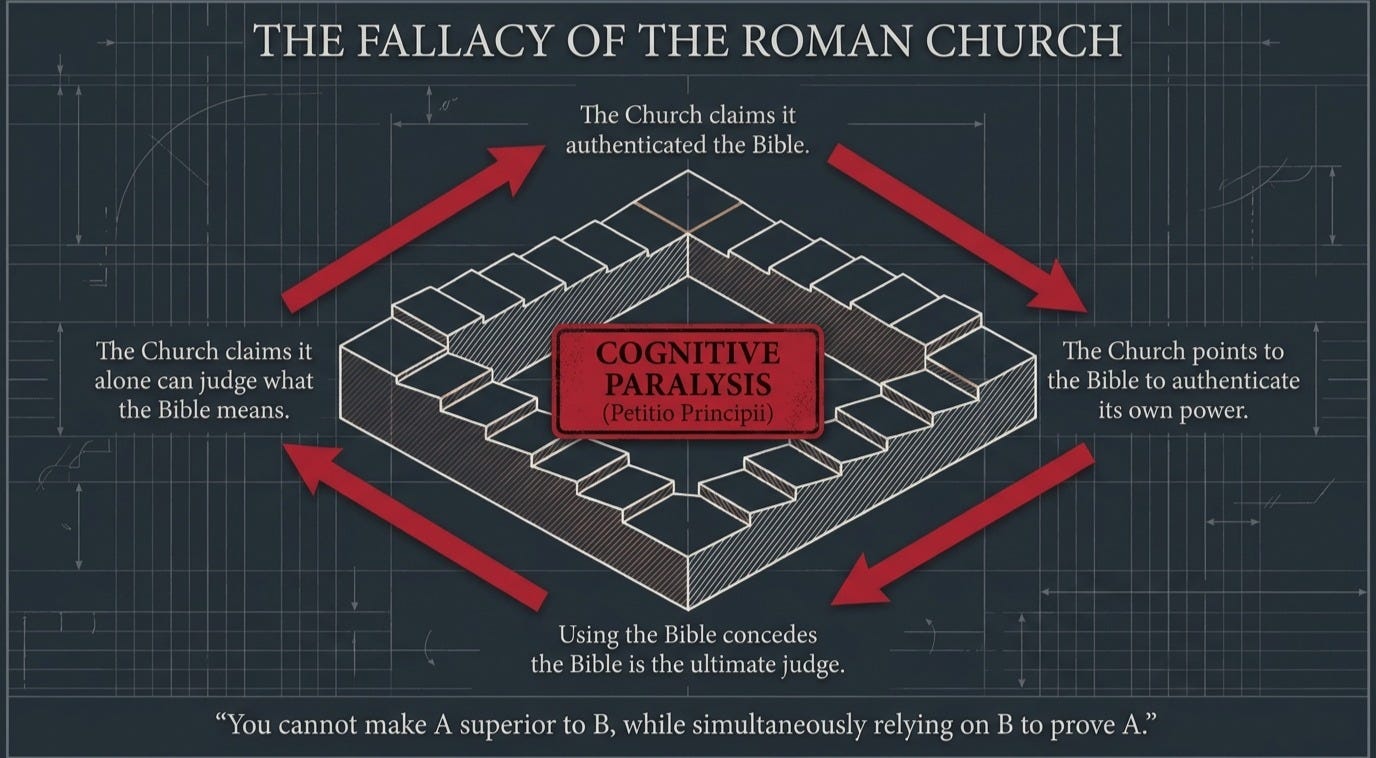
How can an institution prove its supreme authority without relying on that very authority? This core question surrounds the Catholic Church’s claim as the final interpreter of the Bible and Christian faith. Without an independent baseline, such a claim risks becoming an unverifiable, self-anchored system. Catholic doctrine relies on a triadic framework: Sacred Scripture, Sacred Tradition, and the Magisterium (CCC 95). Although presented as co-equal pillars essential for preserving divine revelation, they form a closed logical loop. The Church cites Scripture to support its divine appointment while claiming exclusive, infallible authority to define the canon and its meaning, creating a self-referential structure.
*CCC – Catholic Church Catechism
2. Takeaway 1: The Inseparable Triad: Scripture, Tradition, and Magisterium Cannot Stand Alone
Catholic theology explicitly rejects sola scriptura, teaching that certainty about revealed truths does not derive from Scripture alone (CCC 82). Instead, Scripture and unwritten Tradition must be venerated with equal devotion. Paragraph 95 formalizes their interdependence with the institutional hierarchy: “sacred Tradition, Sacred Scripture, and the Magisterium of the Church are so connected and associated that one of them cannot stand without the others.” This creates a self-reinforcing circuit: Tradition authenticates the biblical canon, canonical Scripture supplies proof-texts for Papal Primacy, and the Magisterium claims exclusive authority to interpret both Scripture and Tradition. By binding these three pillars together, the Church ensures no single component can be isolated to critique the system.
The core logical flaw in the argument regarding the existence of the Roman Synagogue stems from the Begging the Question fallacy. This fallacy occurs when an argument implicitly embeds its unproven conclusion in its starting premise.
3. Takeaway 2: The Church Authenticates the Scripture That Authenticates the Church
The circular dynamic of Catholic authority becomes starkly evident in how the Church defined the Bible itself. According to CCC 120, it was solely through “apostolic Tradition that the Church discerned which writings are to be included in the list of the sacred books.” Through this internal discernment, Rome established the official canon comprising 46 Old Testament books and 27 New Testament books. This structural claim creates a foundational epistemological paradox: ecclesiology is made to precede canonology. The Church routinely cites biblical passages to prove that Jesus Christ conferred ultimate authority on Peter and his successors. Yet, the believer knows those specific texts are inspired Scripture only because the Church previously declared them so. This priority of institutional authority over the sacred text is explicitly affirmed under the Church’s criteria for biblical interpretation in CCC 119, which cites St. Augustine’s famous Patristic declaration to substantiate Rome’s priority over the written word: “But I would not believe in the Gospel, had not the authority of the Catholic Church already moved me.” Because the Bible’s legitimacy rests upon the Church’s prior recognition, Scripture cannot function as an independent, external judge over the Church. The institution serves as its own ultimate witness, authenticating the document it then deploys to validate its supreme authority.
4. Takeaway 3: The “Servant” Magisterium Holds Exclusive Monopoly on Truth
On paper, Roman Catholic doctrine portrays the Magisterium as a modest custodian of divine revelation. Paragraph 86 of the Catechism insists that the teaching office “is not superior to the Word of God, but is its servant,” claiming to teach only what has been handed down through the deposit of faith. However, this stated posture of service is paired with an operational monopoly over interpretation. Paragraphs 85 and 100 explicitly decree that the task of authentically interpreting the word of God has been entrusted “solely to the Magisterium”, defined strictly as the Pope and the bishops in communion with him.
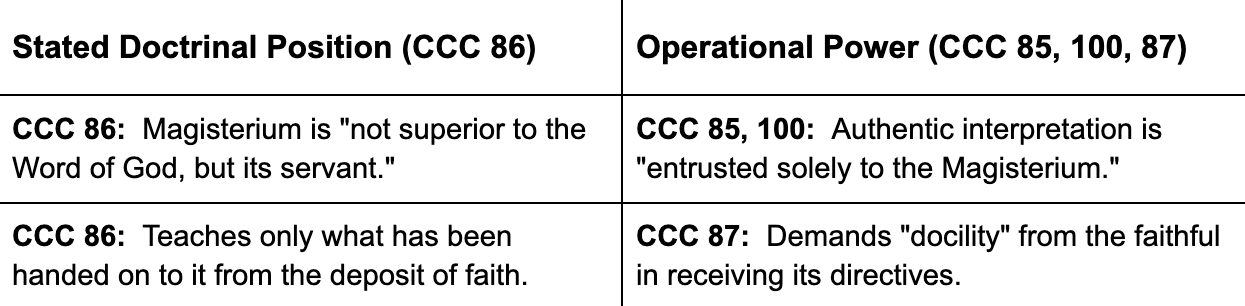
This structure illustrates a classic administrative paradox: when a designated “servant” retains an exclusive monopoly over interpreting the master’s voice, that servant becomes the functional master. By demanding total “docility” from the faithful regarding its directives (CCC 87), the Magisterium insulates its rulings from any external check or individual scriptural evaluation.
*Docility: the quality or state of being easy to teach, manage, control, or discipline. In other words, the Roman Church demands that its followers submit to the Magisterium over the Sacred Scriptures.
5. Takeaway 4: Defining Binding Dogmas and Sacramental Dependence
The Church’s self-validating system governs salvation directly through dogmatic definitions and the sacraments. CCC 88 states the Magisterium exercises Christ’s full authority when defining dogmas, requiring an “irrevocable adherence of faith.” Enforced through the sacramental system, promulgated at the Council of Trent and reaffirmed by Vatican II, the Church decrees sacraments necessary for salvation, rejecting justification by faith alone. Researcher Dave Hunt notes that framing sacraments as an indispensable “mysterium fidei” establishes the priesthood as essential channels. Here, salvation is an incremental process requiring ongoing sacrifices like the Mass and infusions of grace to expiate temporal punishment. This ongoing reliance on priest-administered rituals binds salvation and individual conscience to the institutional machinery.
“If anyone says that the sacraments of the new law are not necessary for salvation and that without them men obtain from God through faith alone the grace of justification, let him be anathema.”
6. Conclusion: The Unshakeable Citadel of Circular Logic
The Catholic Church’s authority structure relies on a self-validating loop. The Church defines the Bible’s canon, uses that canon to prove its own divine authority, and claims exclusive power to interpret the scriptures. By linking Scripture, Tradition, and the Magisterium together, the Church creates a system that resists external criticism. If someone uses Scripture to challenge the Church, the Magisterium asserts its exclusive right to interpret it. This structure raises a central question: How can anyone independently evaluate the Church’s claims when the institution acts as its own ultimate witness?
Acts 17:11 states: “These were more noble than those in Thessalonica, in that they received the word with all readiness of mind, and searched the scriptures daily, whether those things were so.” The believers established a testable standard for evaluating Apostle Paul’s claims. The Bible praises this approach as “noble.” If Scripture is used regularly as the ultimate authority to verify apostolic claims, then it can also validate the claims of the Roman institution without apology.