
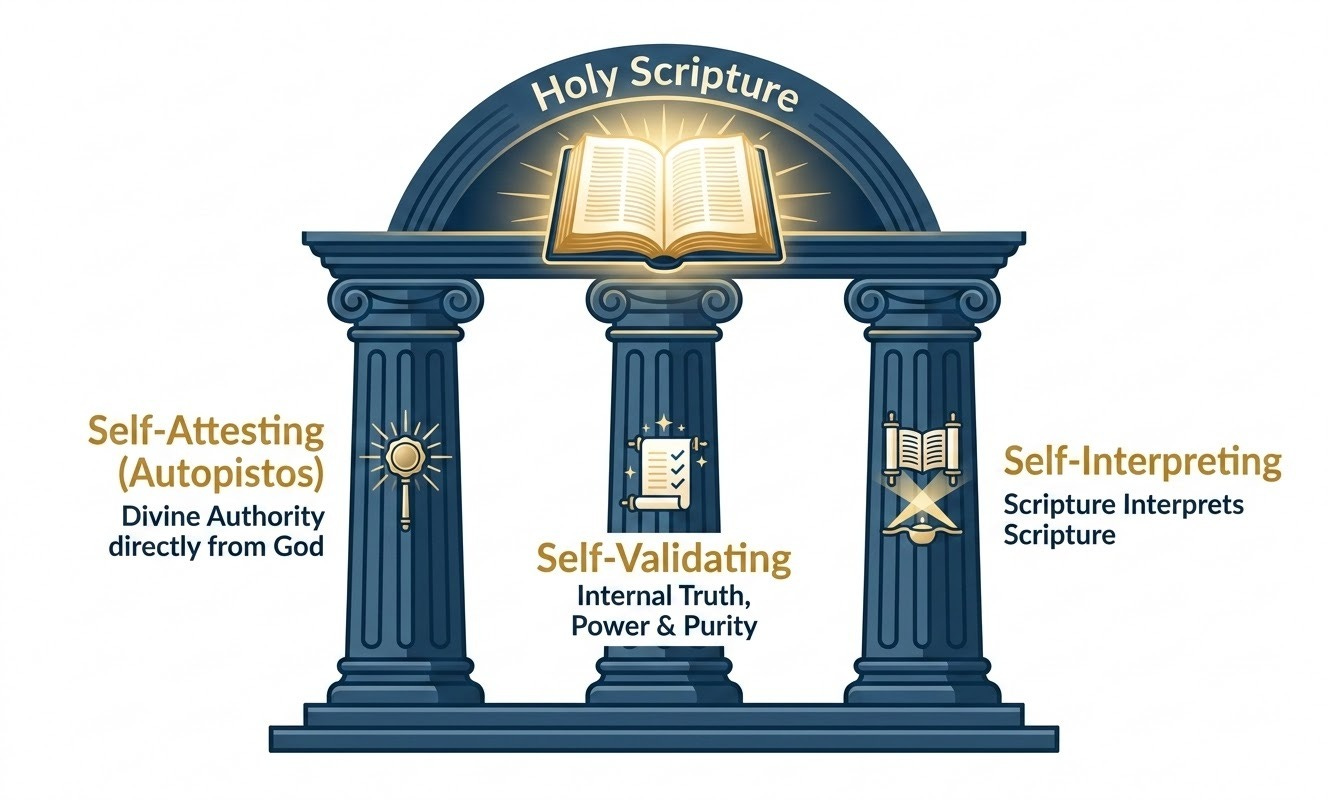
In the King James Bible, the term “Scripture” or “Scriptures” appears 53 times. As Bible-believing Baptists, we see God’s word as our ultimate authority, aligning with the Westminster Divines’ view of Scripture’s nature. It has three main characteristics as Divine literature:
-
It is self-attesting, asserting that it contains God’s very words.
-
It is self-validating, enduring strict internal scrutiny with consistency, coherence, and cogency.
-
Additionally, it is self-interpreting, serving as its own sole commentator.
These three traits distinguish the Bible from all other religious texts in history. No other book, authored by over 40 writers over 1500 years, shares these miraculous characteristics. No human could have intentionally created the Bible.
Considering these facts and allowing the Bible to define its terms, all 53 mentions of ‘Scripture’ reveal 6 attributes related to God’s word. Analyzing these passages shows six key categories about Scripture’s nature, authority, and role.
We find that the Lord never treats the text as an elusive, lost relic. The “Scriptures” are consistently mentioned as concrete, accessible copies and translations.
-
Copies are authoritative as any original. Physical manuscript copies (apographa) carry the same authority, impact, and divine inspiration as God’s original; inerrancy does not apply only to the original autographs, which are no longer available. Key passages: Luke 4:21; Acts 8:32, 35; Acts 17:11; 2 Tim 3:15
-
Inviolable Authority & Inerrancy. Scripture cannot be broken; error arises from ignorance of the text; written Scripture carries the full authority of God’s voice. Key passages: Dan 10:21; Mat 22:29; Mark 12:24; John 10:35; Acts 1:16
-
Christological Fulfillment. All Scripture centers on and finds its fulfillment in Jesus Christ’s life, death, resurrection, and eternal kingdom. Key passages: Luke 24:27, 45; John 5:39; John 19:24-37; 1 Cor 15:3-4
-
Isaiah 41:21-26 reveals that prophecy is the litmus test for Divinity. Only God can foretell the future. Therefore, a book that fulfills prophecy proves itself to be the very words of God.
-
-
Mutual NT & OT Canonicity. The Apostles place the NT Gospels (Luke) and Epistles (Paul) on equal footing with the OT Law and Prophets under the title “Scripture.” Key passages: Rom 1:2; Rom 16:26; 1 Tim 5:18; 2 Pet 3:16
-
Active Agency & Personification. Scripture is personified as speaking, foreseeing, and judging because God speaks directly through the written text (Viva Vox Dei). Key passages: Rom 4:3; Rom 9:17; Gal 3:8, 22; James 2:8, 23; Jas 4:5
-
Rule of Faith & Discernment. All Scripture is God-breathed, self-authenticating, sufficient for doctrine, and the supreme standard for evaluating all claims. Key passages: Rom 15:4; 2 Tim 3:16; 2 Pet 1:20; Acts 17:2, 11; Acts 18:24
The term “Scripture” affirms the Bible as the self-authenticating, infallible word essential for salvation and life. Divine preservation ensures ongoing accessibility by providing believers with authoritative, well-preserved copies. Through derivative inspiration, faithful translations carry the full authority of the apostles, delivering God’s exact truth to all nations.
All scripture is given by inspiration of God, and is profitable for doctrine, for reproof, for correction, for instruction in righteousness: That the man of God may be perfect, throughly furnished unto all good works.
2 Timothy 3:16-17