

The Mind of Faith: Ministerial vs. Magisterial Reasoning, Heavenly Wisdom, and True Philosophy
Many students of the Bible mistakenly believe faith and intellect are at war, or that committing your life to Christ requires turning off your brain. Scripture teaches the opposite: God created the human mind and endowed us with the capacity to think, analyze, and discover truth.
The critical question for a Christian is not whether we should use reason, but how we use it. Historically, Christian theologians distinguish between two opposite ways of using human intellect: ministerial reasoning and magisterial reasoning. This distinction reflects two deep biblical dichotomies: wisdom from below versus wisdom from above (James 3:15, 17), and philosophy after the tradition of men versus philosophy after Christ (Colossians 2:8).
I. Magisterial Reasoning: Wisdom from Below and Vain Deceit
The word magisterial comes from the Latin magister, meaning “master” or “judge.”
Magisterial reasoning occurs when the autonomous human mind judges the word of God. In this approach, human intellect acts as the ultimate filter and supreme authority. If a passage of Scripture conflicts with personal preferences, secular scientific consensus, or cultural trends, the person using magisterial reason feels entitled to correct, reinterpret, or reject God’s word.
1. Grounded in “Wisdom from Below” (James 3:15)
James 3:15 (KJV) describes this autonomous mindset: “This wisdom descendeth not from above, but is earthly, sensual, devilish.”
-
Earthly: It limits its perspective entirely to the material, created order, ignoring divine revelation.
-
Sensual: It elevates human physical senses, feelings, and empirical observation as the highest judge of truth.
-
Devilish: It mirrors the original pride of Satan, who enticed humanity to decide good and evil independently of God.
2. Rooted in “Vain Deceit and the Tradition of Men” (Colossians 2:8)
Paul warns against this exact intellectual trap in Colossians 2:8 (KJV): “Beware lest any man spoil you through philosophy and vain deceit, after the tradition of men, after the rudiments of the world, and not after Christ.” When reasoning operates magisterially, philosophy becomes “vain deceit.” It builds upon the “tradition of men” (human opinions) and the “rudiments of the world” (naturalistic, secular building blocks) rather than divine truth. It treats human reason as autonomous, judging God’s claims rather than submitting to them.
II. Ministerial Reasoning: Wisdom from Above and Philosophy After Christ
The word ministerial comes from the Latin minister, meaning “servant” or “helper.”
Ministerial reasoning occurs when human intellect submits to God’s word as a tool to understand, interpret, and defend Divine Revelation. Under ministerial reason, Scripture is recognized as the ultimate, self-authenticating standard of truth (Sola Scriptura). Human reason does not judge Scripture; rather, Scripture governs human reason.
1. Grounded in “Wisdom from Above” (James 3:17)
James 3:17 (KJV) outlines the character of submitted intellect: “But the wisdom that is from above is first pure, then peaceable, gentle, and easy to be intreated, full of mercy and good fruits, without partiality, and without hypocrisy.”
-
Pure: It submits unreservedly to the holy, inerrant word of God.
-
Without Partiality: It does not twist facts to suit selfish biases or autonomous human agendas.
-
Without Hypocrisy: It maintains complete logical consistency, avoiding the self-refuting fallacies of secular worldviews.
2. Rooted “After Christ”—The Source of All Logic and Wisdom
Colossians 2:8 commands that we think “after Christ.” In Colossians 2:3, Paul explains why: in Christ “are hid all the treasures of wisdom and knowledge.”
Jesus Christ is the Logos—the eternal Word and rational architecture of the universe (John 1:1). Therefore, true philosophy is not anti-intellectual. A Christian does not reject philosophy; rather, the Christian rejects false philosophy (built on human tradition) in favor of true philosophy (built on Christ). Because Christ is the source of all logic and wisdom, using ministerial reason to think biblically is the highest exercise of human intellect.
III. Structural Comparison: The Two Epistemological Paths
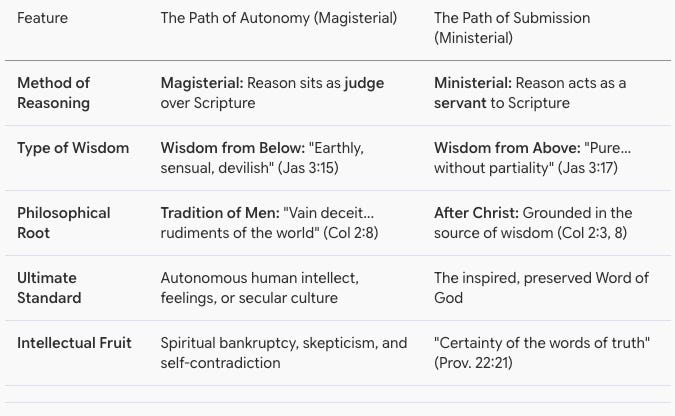
IV. Practical Application for Christian Students
In high school science, history, or literature, practicing ministerial reasoning and choosing wisdom from above looks like this in practice:
-
Evaluating Scientific Claims: You do not ignore empirical data, but you recognize that “facts” are never neutral—they are always interpreted through a worldview. When naturalists claim that life arose spontaneously from non-life, you recognize this as “philosophy after the rudiments of the world.” You use ministerial reason to show that life coming from non-life violates physical law and that order points to a Creator (Romans 1:20).
-
Answering Secular Objections: If a peer claims that the Bible is full of errors, you do not abandon your faith. You recognize that their objection relies on the “tradition of men.” You use ministerial reason to expose their unstated assumption: they assume naturalism before considering the historical or textual evidence.
-
Personal Bible Study: When you encounter a challenging passage in Scripture, you do not ask, “How can I change this text to make it popular with my friends?” (magisterial reason). Instead, you pray for “wisdom from above” and ask, “What does God mean by this text, and how must I align my thinking with His truth?”
Conclusion
Biblical faith is not a blind leap into the dark; it is reason submissively placed in the hands of the Creator. While magisterial reasoning relies on the “wisdom from below” and leads to “vain deceit,” ministerial reasoning honors Jesus Christ as the absolute source of logic, wisdom, and truth. By bringing every thought into captivity to the obedience of Christ (2 Corinthians 10:5), believers gain the intellectual clarity and spiritual certainty needed to defend the faith effectively.