

Assurance is Grounded Upon Belief
True spiritual assurance comes not from chasing endless academic skepticism, but from first choosing to believe what God has said and anchoring our certainty in His infallible word rather than human doubt.
Here are some important observations from this passage:
-
The Priority of Belief and Assurance: When Jesus asked His disciples if they also wanted to leave Him, Simon Peter gave a defining response recorded in John 6:67-69: “Lord, to whom shall we go? thou hast the words of eternal life. And we believe and are sure that thou art that Christ, the Son of the living God.” Notice the sequence of events here, because it reveals a vital spiritual truth. Assurance comes after belief. The disciples did not wait for empirical proof or modern scholarly consensus; they first confessed belief in Christ and in who He claimed to be. That confession of faith is precisely where their confidence and assurance originated.
This foundational moment demonstrates the indispensable importance of belief in Scripture. Faith is not a blind leap into the dark devoid of reason; rather, as Romans 10:17 tells us, faith is simply believing what God said, rooted directly in the word of God. We cannot realistically expect to have assurance in any promise God made unless we first take Him at His word.
John 6:67-69:
“Lord, to whom shall we go? thou hast the words of eternal life. And we believe and are sure that thou art that Christ, the Son of the living God.”
-
The Nature of Faith and Divine Certainty: In the Bible, certainty is treated as a known and knowable quantity. Proverbs 22:20-21 points to this reality, showing that God’s truths can be known with confidence. A powerful illustration of this dynamic appears in Matthew 8:8-10, where the Roman Centurion asks Jesus to heal his servant with a word. The Centurion understood authority; he recognized that Jesus, as God manifest in the flesh, did not need a physical sign, extra proof, or external evidence beyond His own spoken word.
To the Centurion, Christ’s words alone were completely sufficient. His faith rested entirely on the spoken word, and Jesus declared it the greatest demonstration of faith He had witnessed during His earthly ministry. The Centurion was not exercising tentative probability or mere “reliability”—he operated with absolute, unwavering certainty.
-
The Conflict Between Certainty and Skepticism: Despite clear biblical examples, agnostics and skeptics—both inside and outside the church—actively fight against the concept of religious certainty. Critics of a perfect, perfectly preserved Bible often argue for historical reliability while fiercely rejecting absolute certainty. This anti-biblical reasoning is openly championed across modern thought.
The Modern Skeptic Rejects Certainty
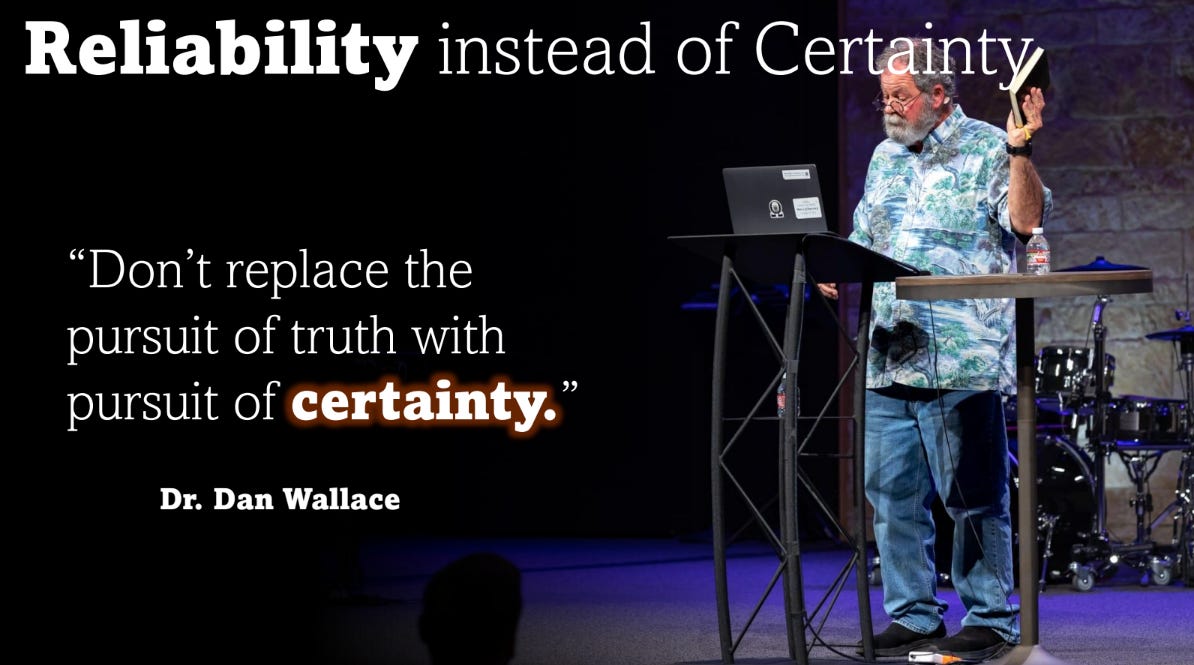
Consider how explicit critics’ rejection of certainty is. Scholar Dr. Dan Wallace famously remarked, “Don’t replace the pursuit of truth with pursuit of certainty.” In his book The King James Only Controversy, James R. White targets the core of biblical confidence, writing: “The ‘argument for certainty’ as I call it…is the ‘glue’ that holds the KJV Only position together…People do not want subjectivity, but desire certainty and clarity…this argument is extremely powerful and should not be underestimated…many Roman Catholics find the idea of an infallible pope very ‘comforting’…Protestants, however, should be quick to question any such notion of absolute religious certainty…as imperfect human beings we will make mistakes.” Pushing this skepticism to its secular extreme, the philosopher Voltaire famously declared, “Doubt is not a pleasant condition, but certainty is absurd.”
The Root of Rejection = Fear
These critics fear certainty because their founding presuppositions rest on humanistic reason, skepticism, and doubt. They operate from a posture that questions God rather than resting in Him. But for the believer, belief remains the essential, axiomatic principle of true assurance. When we stop listening to the shifting sands of human doubt and anchor our hearts in what God has explicitly spoken, genuine assurance naturally follows.