
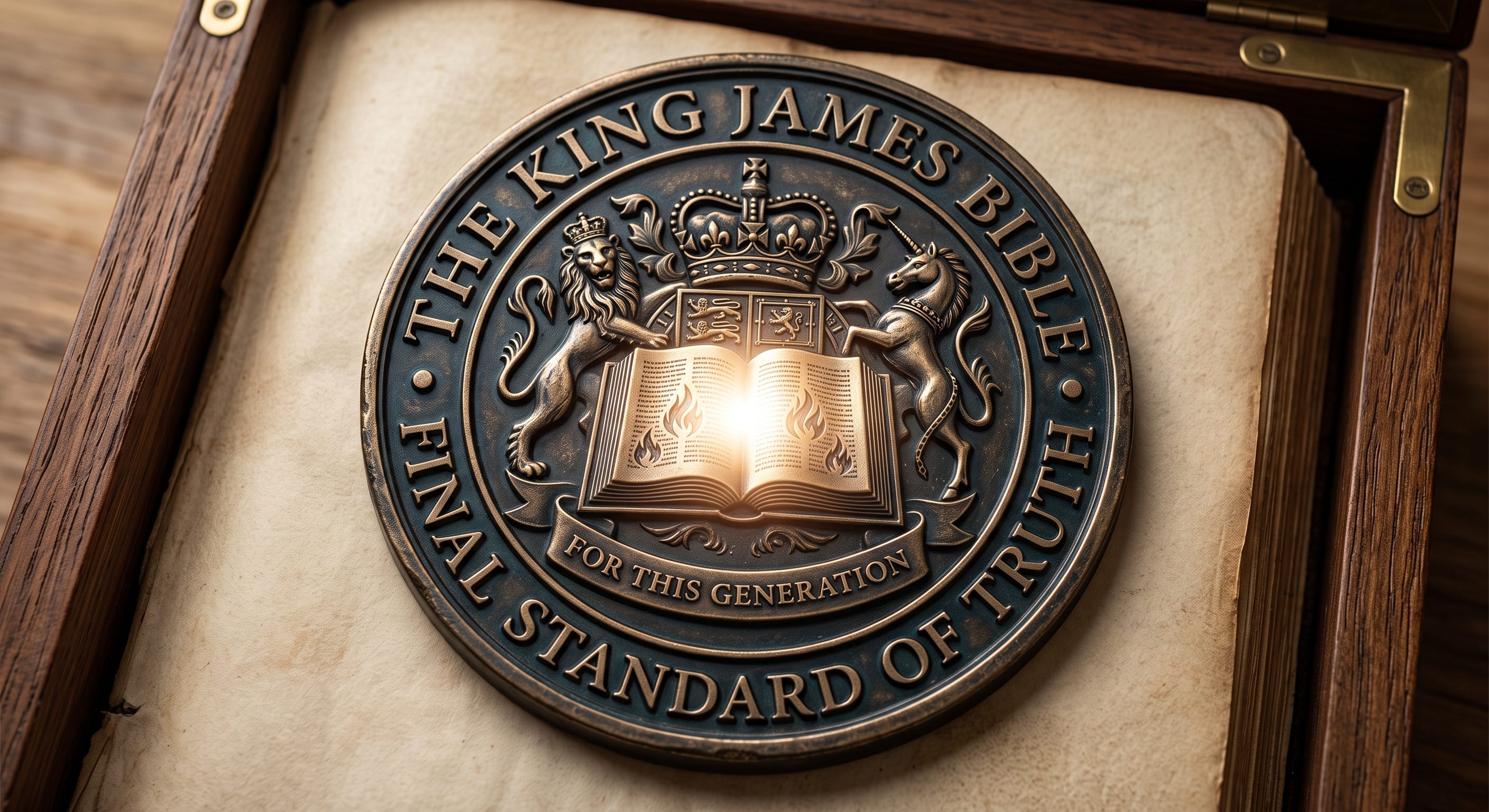
Recently, I met some people who support the Textus Receptus and generally defend the King James Bible against Critical Text proponents. While I see them as allies in the fight for Divine Preservation, their stance is somewhat limiting. They believe the KJV is the best translation but not the ultimate standard of truth.
Their argument relies foundationally upon Matthew 5:18 (“For verily I say unto you, Till heaven and earth pass, one jot or one tittle shall in no wise pass from the law, till all be fulfilled”) to lock preservation into Hebrew grammatical forms.
The arguments of these “TR” supporters rely on several key logical and biblical errors that unintentionally weaken the doctrine of divine preservation they aim to defend. By trying to limit absolute inerrancy and preservation solely to the Greek and Hebrew texts, citing Matthew 5:18, they end up adopting a middle ground that ultimately leads to the same biblical agnosticism they want to avoid.
Here are five reasons why I believe this argument does not hold true:
I. The Matthew 5:18 Fallacy: Legal Fulfillment at Calvary
Their argument relies on Matthew 5:18 (“For verily I say unto you, Till heaven and earth pass, one jot or one tittle shall in no wise pass from the law, till all be fulfilled”) to lock preservation into Hebrew grammatical forms. However, this interpretation completely ignores the explicit covenantal and temporal boundaries Christ placed on that promise.
-
The Temporal Boundary: Christ did not say the “jot and tittle” of the Hebrew script would be the perpetual, universal standard of textual transmission for the church age. He bound that microscopic preservation of the Mosaic code to a specific condition: “till all be fulfilled.”
-
The Calvary Accomplishment: The New Testament explicitly and repeatedly declares that Jesus Christ perfectly, exhaustively fulfilled the law at Calvary:
-
Romans 10:1-4 declares that “Christ is the end of the law for righteousness to every one that believeth.”
-
Galatians 3:13, 19-26 shows that Christ redeemed us from the curse of the law, which was merely a temporary schoolmaster.
-
Hebrews 10:9-10 confirms that He “taketh away the first, that he may establish the second,” sanctifying us once for all.
-
Acts 1:16 and 3:18 demonstrate that the things God showed by the mouth of all His prophets have been completely fulfilled.
-
-
The Covenantal Shift: Because Christ fully accomplished the righteous requirements of the law at the cross, the covenantal requirement for the physical, orthographic “jot and tittle” of the Hebrew temple scrolls was legally and spiritually met. Insisting that the church today is textually bound to Hebrew orthography misses the transition from the Old Covenant to the New.
II. The Absurdity of the “Jot and Tittle” Argument Applied to the Greek
By leveraging Matthew 5:18 to argue for preservation in “the original languages” (both Hebrew and Greek), they trap themselves in a devastating logical and linguistic self-contradiction.
-
Greek Has No Jot or Tittle: A “jot” (yod) is the smallest letter of the Hebrew alphabet. A “tittle” is a tiny horn or ornamental pen stroke that distinguishes one Hebrew letter from another (such as a dalet from a resh). The Greek language contains absolutely no jot or tittle.
-
The Self-Destruction of Your Standard: If Matthew 5:18 dictates that perfect preservation is bound strictly to the physical, orthographic features of the Hebrew script, then by your own standard, the Greek New Testament is completely unpreserved and invalid.
-
The Double Standard: You are attempting to make a Hebrew-specific orthographic promise cross a linguistic boundary to validate your Greek Textus Receptus, while simultaneously denying that same divine power can preserve those same words into English. If Greek can be a perfectly preserved vehicle of God’s word without possessing a single “jot” or “tittle,” then English can be as well.
III. The Minimum Level of Preservation: The “Words” of Scripture
If physical “jots and tittle” (Hebrew pen strokes) served a covenantal purpose that was fulfilled at Calvary, where does that leave the promise of preservation? The Bible’s own testimony is that overall, ongoing preservation is promised to the “words” of Scripture, not to regional alphabets or dead scripts.
-
Psalm 12:6-7 promises: “The words of the Lord are pure words… Thou shalt keep them, O Lord, thou shalt preserve them from this generation for ever.” The grammatical antecedent is words, not letters.
-
Isaiah 40:8 declares: “The grass withereth, the flower fadeth: but the word of our God shall stand for ever.”
-
Matthew 4:4 commands man to live by “every word” that proceeds out of the mouth of God.
This is the divine minimum level of preservation: the exact, verbal substance (words) of God’s revelation. The Greek and Hebrew languages are merely the initial vessels; the words themselves are what God promised to keep pure in all ages. The King James Bible perfectly satisfies this deductive promise by translating the exact verbal substance of the preserved Traditional Text family into English.
IV. The Scriptural Precedent of Authoritative Translation
They claim that a translation cannot serve as the absolute, perfect standard of truth, which is flatly contradicted by the behavior of Scripture itself:
-
The Genesis Precedent: When Joseph spoke Egyptian to an interpreter, who translated his words into Hebrew for his brothers, Moses recorded that translated exchange under the inspiration of the Holy Spirit as the pure, inerrant word of God (Genesis 42).
-
The Acts 22 Precedent: When the Apostle Paul delivered his entire defense in the Hebrew tongue (Acts 21:40, 22:2), the Holy Spirit inspired Luke to record that speech word-for-word in Greek. The Greek text is an inspired translation of Paul’s spoken Hebrew. If a translation cannot carry absolute divine authority, then Luke’s Greek account of Paul’s speech is a flawed, secondary approximation.
-
The Pentecost Precedent: The very first public act of the Holy Spirit after the resurrection was the miracle of translation at Pentecost (Acts 2). God bypassed a single-source language to propagate His pure, authoritative truth into fourteen distinct national tongues simultaneously.
Scripture makes no promise that God would restrict His perfectly preserved words to Hebrew and Greek. To the contrary, Scripture shows that God actively validates translation as a legitimate, fully authoritative vehicle for His words.
V. The Presuppositional Method: We Conclude with the KJV
As consistent, presuppositional Bible believers, we do not start with the KJV; we conclude with it based on the scriptural standards deduced from the word of God.
Our logical chain follows a rigorous, non-arbitrary progression:
[The Nature of God] ──► [The Promise of Word Preservation] ──► [The Requirement of Accessibility] ──► [The Historical Translation Culmination (KJV)]
-
Major Premise (The Character of God): God is perfectly truthful, sovereign, and consistent (Titus 1:2).
-
Minor Premise (The Promise of Word Preservation): Based on His character, God promised to preserve His words—not regional letters or scripts—perfectly for all generations (Psalm 12:6-7, Matthew 24:35).
-
Sub-Premise (The Moral Imperative): God commands us to read, study, and live by “every word” (Matthew 4:4; 2 Timothy 2:15). Because an unavailable authority is a logical contradiction, a perfectly preserved, tangible standard of those exact words must be accessible to the believer today.
-
The Historical Evidence: Koine Greek died as a spoken language around A.D. 800. Since the original manuscripts are gone and the original tongues are dead to the modern world, God’s promise of continuous accessibility requires a perfect translation in the universal language of the modern world (English).
-
The Culmination: When we examine history, the King James Bible represents the crowning, finalized purification of the Received Text line. It was translated during a unique providential window (1611), before the rise of Enlightenment skepticism, German rationalism, and modern textual criticism. Through linguistic submission, it forced English syntax to speak in Hebraic and Greek formal structures, creating a grammatically perfect, self-interpreting mirror of the preserved texts.
-
Supporting Conclusion: When evaluated by the self-attesting testimony of Scripture’s own perfection, integrity, and absolute spiritual authority, which perfectly mirrors the immutable nature and character of God, there exists a divine standard of measurement for modern translations, and only the King James Bible consistently reflects this internal, self-authenticating benchmark while maintaining the absolute preeminence of the Lord Jesus Christ in all things.
We do not believe the KJV is perfect because we arbitrarily prefer 17th-century English. We believe it is perfect because the KJV is the only tangible Book on earth today that successfully meets the deductive, scriptural requirements of divine word-level preservation. To reject this conclusion is to step onto a naturalistic trajectory that inevitably ends in total textual agnosticism.