
Facebook offers an endless supply of rich material to analyze alleged “Christians” consumed by the fact that God did not preserve His words in a tangible, inerrant, and perfect form.
Here’s one interaction that I thought would be educational to critique.
Background
Patrick Caldwell challenged the belief that a perfect translation of the originals exists today. After I posted about the importance of meaning tied to explicit words, Patrick claimed that words change with “translations” and asked how a translation can be validated as the perfect words of God.
Fair question.
I explained that if God was part of the process and authorized the translation, it would bear the Author’s marks and characteristics. If God is immutable, inerrant, pure, holy, and non-contradictory, then the translation would be as well.
In any interaction, I will always assume the other side is genuinely interested in the proposition and would hear out the argument. But in my heart of hearts, I know the person I am dealing with has come to the table with some biases.
The Challenge
Patrick responded with a question laden with humanistic assumptions. He asked if these characteristics were “evidentiary” and whether they could be “neutrally assessed.” Without directly acknowledging it, Mr. Caldwell is operating from a Scripture-based view with a “pretended neutrality” posture. He argues that any translation claiming to be God’s words must be validated with empirical evidence and “assessed” through humanistic examination.
Needed Clarification
Realizing I was dealing with another Bible agnostic, I needed to reset the conversation and ask a clarifying question. I asked whether Patrick believed he possessed a tangible, infallible, inerrant Bible today.
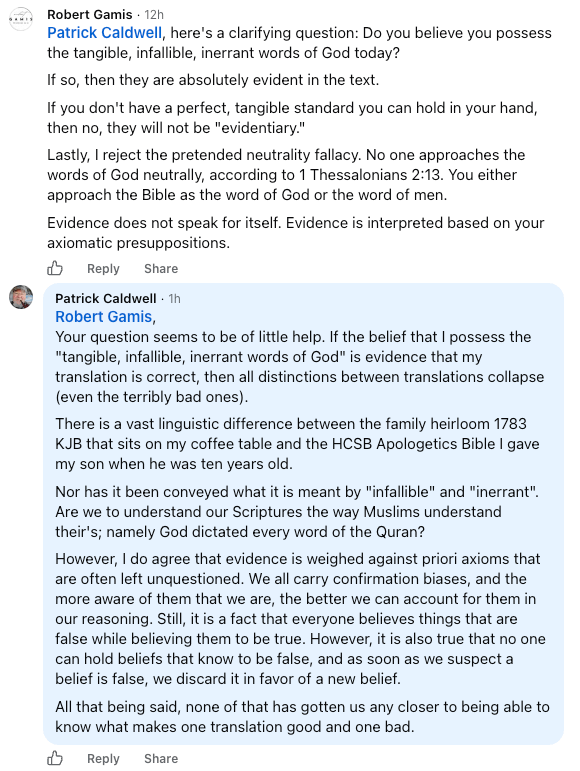
Below is the screen capture of the conversation. Patrick’s response prompted this post.
The Critique of Unbelief
You can read the details for yourself. My focus is to target the logical & biblical inconsistencies that underlie Patrick’s thinking.
-
False Equivalence. Patrick first claims that by believing in a perfect Bible you can hold in your hands, then “all distinctions between translations collapse,” pointing to the difference between a 1783 KJB heirloom and an HCSB Apologetics Bible. Then compares the KJVO advocates’ belief to that of a Muslim who views the Quran with equal reverence.
-
This is a category mistake and a red herring. A presuppositional preservationist (KJVO advocate) does not argue that every English translation ever printed is the infallible standard. We recognize that God providentially preserved His words through a specific line of manuscripts which ended in a final text – the King James Bible.
-
This belief is derived from an understanding of what God says about His own words. Scripture explicitly and implicitly demonstrates the process of inspiration, transcription, transmission, and translation. God’s words are self-authenticating, self-validating, and self-interpreting. This is the starting point. This is the standard.
-
Moreover, comparing Christian verbal preservation to the Islamic mechanical recitation of the Quran overlooks the active yet guided role of human agency under the Holy Spirit. Patrick tries to establish a slippery slope whereby any difference in translation undermines the presence of a pure standard.
-
-
The Illusion of Intellectual Neutrality. Patrick accuses me of relying on “a priori axioms,” confirmation biases, and holding false beliefs while believing them to be true, noting that no one knowingly holds false beliefs.
-
This is projection. Mr. Caldwell pretends to approach his criticism of me from a “neutral” academic platform, yet operates entirely from an unacknowledged naturalistic presupposition: that the originals were lost and now it is man’s responsibility to discover and reconstruct them through the science of textual criticism. Patrick commits the “Pretended Neutrality Fallacy”.
-
Pretended Neutrality Fallacy: The misleading idea that scholars can or should interpret the Bible without bias, treating it like any other ancient text (Lachmann’s axiom) without assuming its divine inspiration or preservation. The scripture sees this stance as spiritual rebellion and idolatry (1 Thess 2:13, Isa 66:2, Ezek 14:3–5).
-
-
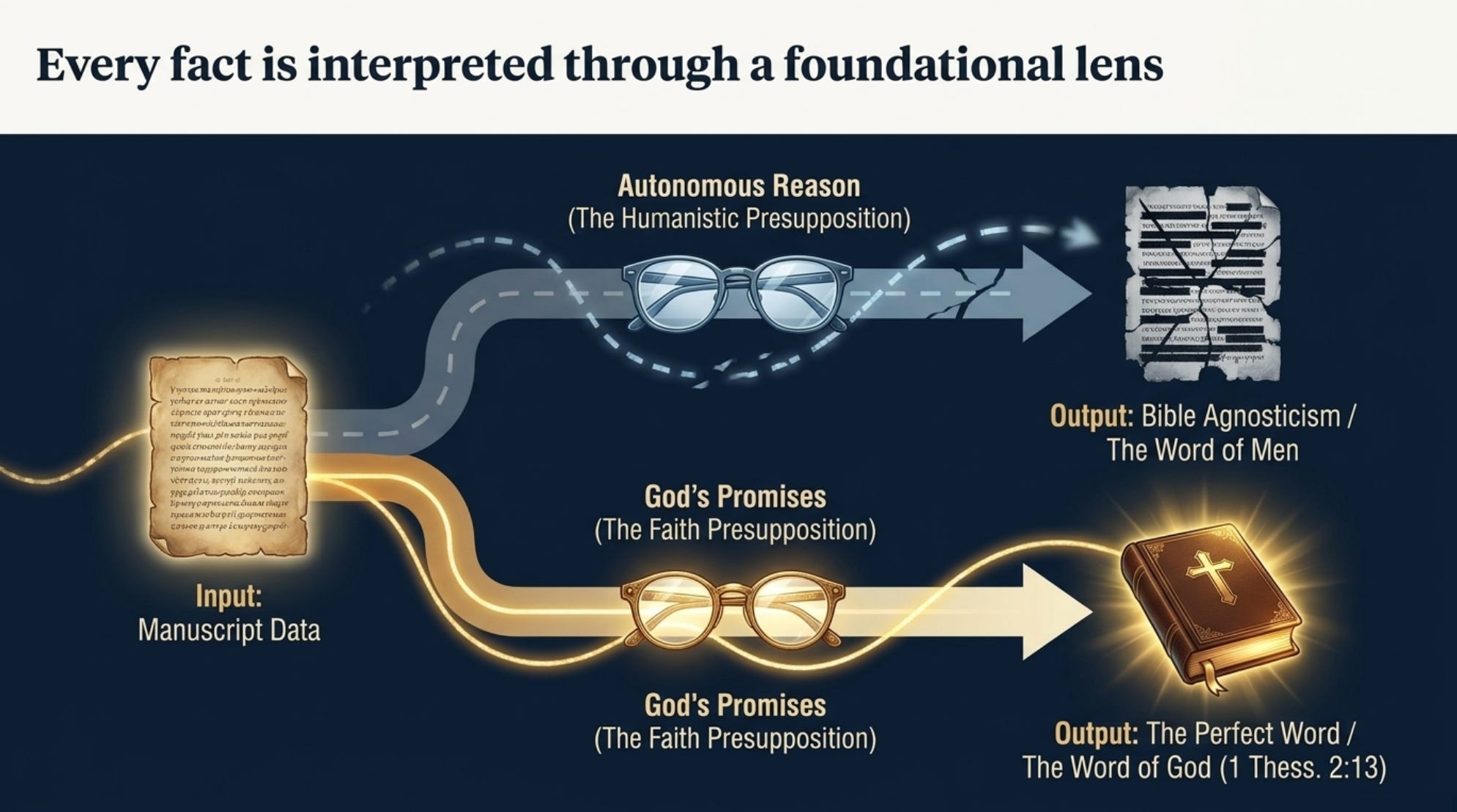
There is no neutral ground. Mr. Caldwell relies on human reason and textual criticism as his final authority. Everyone approaches the Bible issue from one of two directions: a propositional faith foundation – believing what the Bible says about itself or an autonomous reasoning foundation – believing what scholars say about the Bible.
-
-
Textbook “Bible Agnosticism”. Patrick Caldwell concludes, “All that being said, none of that has gotten us any closer to being able to know what makes one translation good and one bad.”
-
Checkmate. This final sentence by “brother” Caldwell is the textbook definition of Bible Agnosticism. He openly admits that after decades of modern textual criticism, variant hunting, and scholarly translation committees, he has no absolute standard to determine what constitutes the pure words of God. Patrick is left with an epistemological vacuum of “shifting sand.”
-
Conclusion
Patrick Caldwell’s comments exemplify why modern day Bible agnostics leave themselves and others who blindly follow them in a state of perpetual doubt. By demanding that I justify my faith using his secular reasoning he subtly attempts to place scholarship in judgment over the word of God.
Patrick has no Bible
Patrick has no perfect standard to measure truth by his own admission. How can he rightly criticize the King James Bible with no final authority greater than God’s word? Patrick Caldwell’s logic fails because his assertion elevates his opinion above what God said.
Everyone approaches the Bible issue from one of two directions: a propositional faith foundation – believing what the Bible says about itself or an autonomous reasoning foundation – believing what scholars say about the Bible.