
No New Thing
As with most heresies, we rarely see anything new. Open Theism is one such example. The Bible declares:
“The thing that hath been, it is that which shall be; and that which is done is that which shall be done: and there is no new thing under the sun.” Ecclesiastes 1:9
Open Theism is nothing more than repackaged Socinianism and Pelagianism. Its core tenet is that God does not know future free-will choices; the future is open and uncertain; God learns, adapts, and reacts to human choices in real time. Based on my observation, Open Theism emerges as a counter-response to Calvinistic determinism. Interestingly, both theological perspectives draw on similar principles without realizing it—specifically, that foreknowledge and causality are essentially identical.
As with most cults and heresies, two primary categories are under attack:
-
Christology – the nature and identity of Jesus Christ (and God subsequently).
-
Soteriology – the nature and doctrine of salvation.
To provide some background on the roots of Open Theism, here’s a high-level explanation of both Socinianism and Pelagianism:
-
Pelagianism denies original sin and inherited guilt, asserting that humans have complete free will to attain righteousness without relying on divine grace.
-
Socinianism is a heresy rooted in rationalism that dismisses Christ’s deity, the Trinity, miracles, and the idea of substitutionary blood atonement, instead equating faith with human reason. It emphasizes human autonomy over God’s divine will.
From a Christological perspective, Open Theism challenges the notions of divine omniscience, immutability, and sovereign preexistence. It weakens prophetic assurances concerning Christ’s return and His kingdom. From a Soteriological standpoint, Open Theism questions the certainty of divine providence and eternal security, suggesting that God’s ultimate plans depend on human choices.
SteelMan
The Bible rebukes misrepresentation in Proverbs 18:13: “He that answereth a matter before he heareth it, it is folly and shame unto him.” So, we must state the Open Theist position fairly and strongly to refute this false teaching.
Open Theists base their theology on three primary arguments:
-
The Free Will Argument: Open Theists argue that if God knows with 100% certainty what you will choose tomorrow, then your choice is already locked in and unchangeable. They claim that for human free choice to be genuine, the future must remain open and unwritten.
-
The Problem of Evil Argument: They claim that if God eternally knew every detail of future history before creation, He directly ordained all evil and suffering. By limiting God’s foreknowledge, they attempt to ‘rescue’ God’s character from the responsibility of human sin.
-
The ‘Relenting’ Bible Verses: They point to narrative accounts where Scripture describes God as ‘repenting’ or ‘relenting’ (such as Jonah 3:10 in Nineveh or Hezekiah in Isaiah 38:5) or where God says ‘Now I know’ (Genesis 22:12), claiming these passages prove God learns new facts in real time.
John M. Combs
In his book promoting Open Theism, Independent Baptist and KJVO author John M. Combs begins by quoting 1 John 3:20 (‘God is greater than our heart, and knoweth all things’), but immediately attempts to chip away at its plain meaning by asking a series of speculative, human-centered ‘what-if’ questions.
Excerpt from John M. Combs’ Introduction:
‘For if our heart condemn us, God is greater than our heart, and knoweth all things.’ – 1 John 3:20. But what exactly do the Scriptures mean when they state that God ‘knoweth all’? If God has literally known everything that ever was and ever will be since before Genesis 1:1 then what pleasure can He take in His creation? If God is omniscient according to the common, man-made understanding of the term, then why bring all of the animals to Adam to see what he would call them? Can God be curious? If God knows all since before the creation then what is the point in man producing new art exhalting God for His pleasure? If God designed a universe in which He already knew the action and end of every living creature how could man have freewill?’
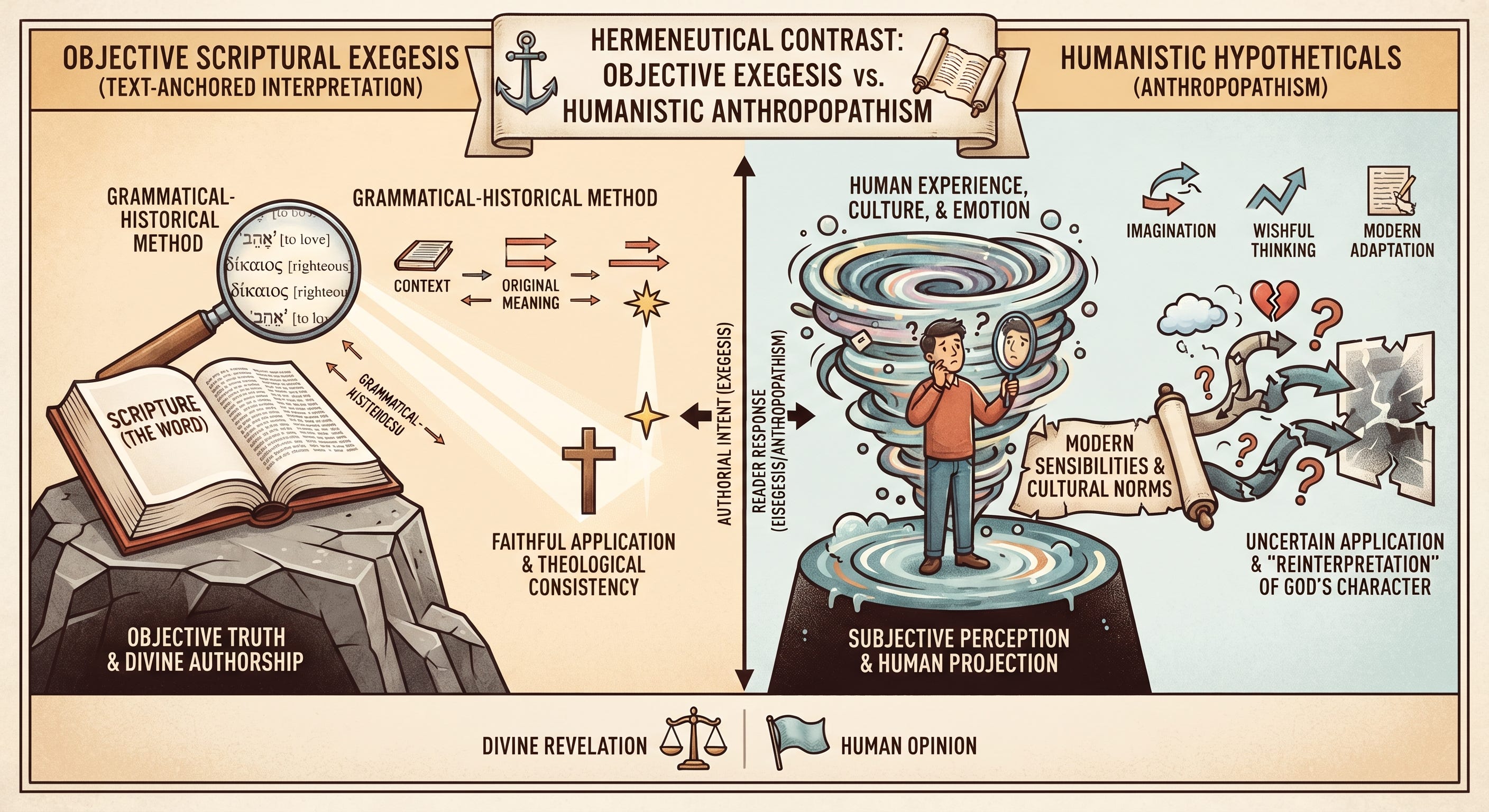
It is unfortunate that a Bible-believing Christian is blind to his own Hermeneutical and Epistemological Error. And rather than take God at His word, Combs must inject his own humanistic reading into the text by proposing hypotheticals to replace explicit doctrinal principles and precepts.
Deconstructing Combs’ 4 Fallacious Challenges:
-
‘What pleasure can God take if He already knows everything?’
-
The Fallacy: Humanizing God (Anthropopathism Run Amok). Combs assumes God’s psychology operates like a finite human brain—that joy requires ‘surprise’ or ‘suspense.’
-
The Biblical Rebuttal: God’s pleasure does not come from being surprised by humans, but from fulfilling and executing His own sovereign, holy will (Revelation 4:11; Ephesians 1:9, 11). To claim God needs surprise to experience pleasure reduces God to a needy creature dependent on man for entertainment.
-
-
‘Why bring animals to Adam to see what he’d call them? Can God be curious?’
-
The Fallacy: Confusing Teaching Tools with Divine Ignorance. Curiosity implies a lack of information. Yet Psalm 147:5 states God’s ‘understanding is infinite.’
-
The Biblical Rebuttal: Bringing animals to Adam was a pedagogical (teaching) exercise for Adam, not for God. God brought the animals so Adam would realize his own need for a companion (Genesis 2:20). God already knew what Adam would name them; Adam needed self-discovery.
-
-
‘What is the point of producing new creative art or worship for God?’
-
The Fallacy: Misunderstanding the Purpose of Worship. Combs assumes worship is meant to give God new data or startle Him with novelty.
-
The Biblical Rebuttal: Worship is about giving God the glory, honor, and obedience due His name (Psalm 96:8). God eternally ordained both the end (His praise) and the means (our creative worship). Knowing a hymn will be written does not make it any less pleasing when poured out from a loving heart.
-
-
‘How could man have free will if God knew the end of every creature?’
-
The Fallacy: The Modal Fallacy (Confusing Certainty with Coercion). Combs assumes that if God knows a future choice, He forces that choice to happen.
-
The Biblical Rebuttal: Foreknowledge is observation, not causation. God’s timeless, eternal vantage point sees the actual, uncoerced choice a man will make tomorrow. The choice remains man’s moral responsibility, but God’s mind has eternally settled the outcome (Acts 2:23; Acts 15:18).
-
Biblical Refutation
When examined through a literal, dispensational interpretation of the Bible, Open Theism falls apart.
-
Rightly Dividing Narrative Stories vs. Clear Didactic Texts: A fundamental rule of Bible interpretation is that explicit, clear doctrinal passages must govern historical story narratives. Explicit verses like 1 John 3:20 (’God… knoweth all things’) and Isaiah 46:9–10 (’Declaring the end from the beginning’) establish divine omniscience. Stories where God ‘relents’ (like Jonah) are anthropopathism—human language used to describe how God’s unchanging holy character responds when men change their posture. To suggest otherwise creates contradictions in Scripture and God’s revealed character (Num. 23:19; Heb. 6:18; Titus 1:2). We should never interpret obscure or unclear passages apart from clear passages.
-
The Hypostatic Union (Christ’s Two Natures): When Open Theists ask why Jesus ‘grew in wisdom’ (Luke 2:52) or ‘learned obedience’ (Hebrews 5:8), they ignore the Incarnation. Jesus Christ is 100% God and 100% Man. As eternal God, He possesses exhaustive omniscience (John 21:17; Colossians 2:3). As a man under the Law, He voluntarily accepted physical and temporal human limitations (Philippians 2:6–8). ‘Learning obedience’ refers to experiential realization on the cross, not ignorance in the Godhead. For example, Psa 121:4 declares that God never slumbers or sleeps. Yet Matthew 8:24 says God sleeps. If we interpret these passages through the lens of Open Theism, we must admit a clear contradiction. A Bible believer reconciles this ‘apparent’ contradiction by understanding that we are dealing with two natures of Christ.
-
Infallibility of Prophecy: Under Open Theism, prophecy becomes a series of educated guesses or conditional predictions that human choices could derail. But in dispensationalism, biblical prophecy is the unalterable declaration of God’s immutable decree regarding the ages (Acts 15:18; Romans 11:25–29).
Reductio Ad Absurdum of Open Theism
When taken to its logical conclusion, Open Theism causes the foundational doctrines of the Christian faith to collapse entirely:
-
Destroys Divine Immutability: If God learns, experiences surprise, or changes His plans, He is mutable (changeable). This violates Malachi 3:6 (’For I am the LORD, I change not’).
-
Destroys Prophetic Infallibility: If the future is open, detailed prophecies (like Christ’s exact crucifixion details or end-times timelines) lose their certainty and become cosmic wagers.
-
Destroys Believer’s Security & Comfort: A God who is ignorant of tomorrow cannot guarantee that ‘all things work together for good’ (Romans 8:28), reducing salvation and providence to guesswork.
-
Makes Scripture Contradict Itself: If 1 John 3:20 says God ‘knoweth all things’, but Open Theists say He doesn’t know the future, they accuse the Bible of falsehood.
Conclusion
In his book’s introduction (available on Amazon), John M. Combs claims that the theological doctrine of God’s omniscience is “man-made.” This is an intriguing assertion, but Scripture doesn’t support it. Combs’ claim holds only if Scripture’s straightforward statements are wrong. For example, 1 John 3:20 clearly states something that should be taken at face value, or it doesn’t. If your theology pushes you to reinterpret Scripture to fit your limited understanding of hermeneutics, you might be idolizing your own perspective rather than truly respecting Scripture (Ezekiel 14:3-4)
Christians attracted to this heresy are dissatisfied with Scripture’s clear meaning. Instead of trusting God’s character and integrity through proper interpretation, they elevate their intellect and adopt Open Theism as their guiding belief.