
Identifying Objective Truth
Have you ever stopped to wonder how you actually know that two plus two equals four, or that the screen in front of you is real?
In philosophy, asking how we know what we know is called epistemology (eh-pis-teh-MAH-luh-jee). Most people never think about it. But astrophysicist and Christian author Dr. Jason Lisle points out something fascinating: if the secular, naturalist view of the universe were true, we couldn’t prove or know anything at all.
What Is Naturalism?
To see why, we first need to define naturalism. Naturalism is the popular secular worldview that the physical world—matter and energy—is all that exists. According to this view, there is no God, no spiritual realm, and the universe is simply the accidental result of a Big Bang followed by billions of years of random chance and biological evolution.
At first glance, naturalism claims to be scientific and objective. But underneath the surface, it is completely bankrupt.
The Chemical Brain Dilemma
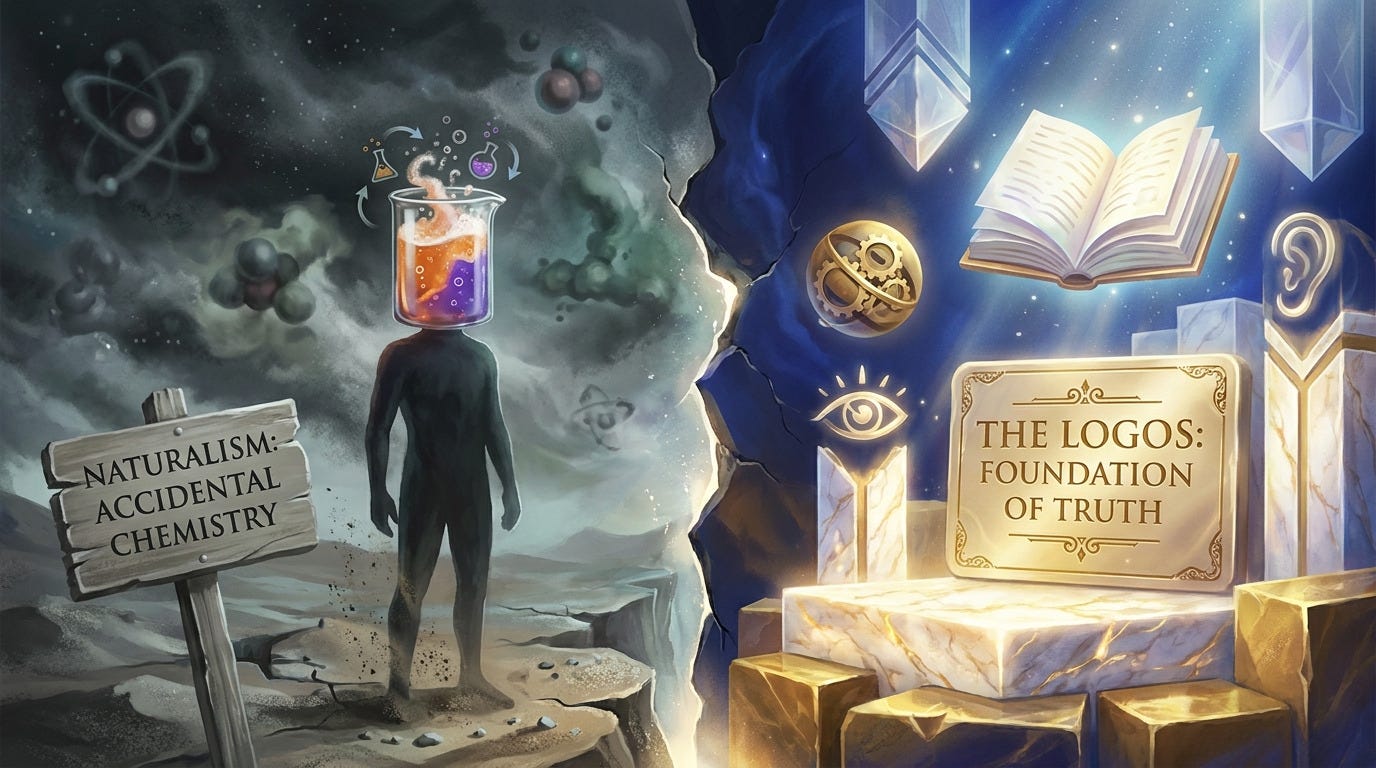
Think about what naturalism actually does to the human mind. If you are just the unplanned product of chemistry over time, then your brain is literally just fizzing chemicals.
Here is the problem: chemistry has no choice.
When you drop an antacid tablet into a glass of water, it fizzes according to fixed laws of nature. The bubbles don’t care about truth, logic, or reality. If your thoughts are merely accidental chemical reactions inside your skull, why should you trust them to deliver objective truth? Objective truth simply means a fact that is true for everyone, whether they believe it or not. As Dr. Lisle asks, you wouldn’t look at the random fizz in a soda bottle to discover truth, so why would you trust a brain that is just chemistry?
Objective truth simply means a fact that is true for everyone, whether they believe it or not.
The same problem ruins our five senses. Naturalism claims our eyes and ears are accidental evolutionary mutations that stuck around purely for physical survival. But as Lisle notes, chlorophyll helps grass survive, yet chlorophyll conveys zero truth about the outside world. Without an intentional Creator, a naturalist has no rational reason to trust their own eyes.
The Laws of Logic
It gets even worse when naturalists try to use logic.
The laws of logic (like the rule that a statement cannot be both true and false at the same time) are not physical objects. You can’t weigh a law of logic or trip over one in the hallway. Furthermore, they are invariant (they never change) and universal (they work the same on Earth as they do in the Andromeda Galaxy).
How can a changing universe made purely of physical atoms explain unchanging, invisible rules of thought? Naturalists cannot say humans invented them, because logic existed long before humans walked the Earth. They cannot say nature created them, because rocks and stars constantly change, while logic never does.
How can a changing universe made purely of physical atoms explain unchanging, invisible rules of thought?
The Impossibility of the Contrary
This brings us to Dr. Lisle’s central argument: the impossibility of the contrary.
Proving that God exists does not mean treating God as an educated guess at the end of a science experiment. Rather, without the God of the Bible, you cannot make sense of science, truth, or logic in the first place.
The Christian worldview gives us the necessary foundation (preconditions) for knowledge:
-
We can trust our minds because we are made in the image of a rational God (Genesis 1:26–27; Isaiah 1:18).
-
We can trust our senses because God purposefully designed the hearing ear and the seeing eye (Proverbs 20:12).
-
We can trust the laws of logic because they reflect the unchanging mind of God (Titus 1:2; 2 Timothy 2:13).
As Scripture plainly declares, “The fear of the LORD is the beginning of knowledge” (Proverbs 1:7). In Jesus Christ “are hid all the treasures of wisdom and knowledge” (Colossians 2:3).
Unbelievers discover facts and do great science by borrowing God’s tools. When they use logic to argue against God, they confirm Romans 1: they elevate creation (nature) above the Creator. It’s a self-defeating proposition. It’s like arguing that air does not exist, while breathing it.
Psa 14:1 – “The fool hath said in his heart, There is no God. They are corrupt, they have done abominable works, there is none that doeth good.”
Eph 4:17 – “This I say therefore, and testify in the Lord, that ye henceforth walk not as other Gentiles walk, in the vanity of their mind…”