
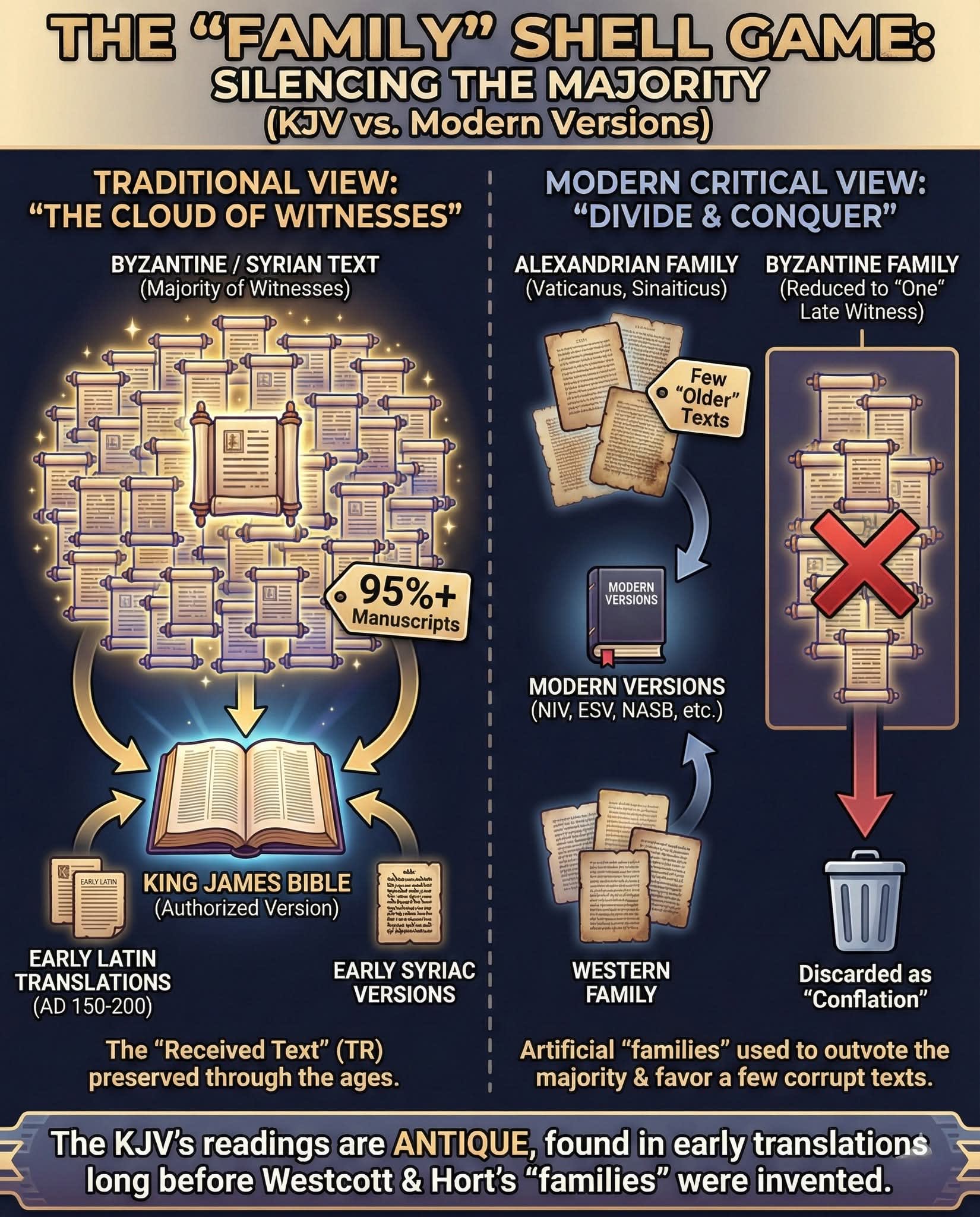
In online debates surrounding Bible translations, a common accusation leveled against the King James Bible is that its underlying Greek text rests upon merely “a few late 16th-century manuscripts.” Critics imply that modern versions possess superior antiquity and are backed by scientific textual criticism, while portraying the KJV as an inferior translation riddled with later scribal additions.
This narrative is perpetuated by many modern scholars, as seen in these typical examples:
The Allegations
Noted scholar Philip Schaff observed that the King James Version was derived principally from early editions of the Greek text compiled by Erasmus (1469-1536), who never used more than eight manuscripts (late in date)… The Textus Receptus ‘ruled supreme’ as the textual base for the Bible from the 16th century to the close of the 18th.” — Wayne Jackson, Christian Courier
“Clearly, some of the passages included in the Textus Receptus, and consequently in the King James Version, are woefully lacking in credentials… For example… 1 John 5:7-8, which is only found in four late Greek MSS from the 14th century onwards…” — Bruce Metzger, referenced on BibleTexts.com
“[Erasmus’s text] was also based on a very small number of late Greek manuscripts that Erasmus had on hand in Basle, dating from the twelfth century onwards.” — Precious Seed International
The Facts
However, in their pursuit to undermine the traditional text, these critics overlook—or deliberately ignore—the great manuscript “heist” of the 19th century. This was a strategic reclassification designed to neutralize the overwhelming majority of witnesses supporting the Received Text.
For centuries, the body of Christ relied on the text found in over 95% of existing Greek manuscripts. But 19th-century textual critics devised a “divide and conquer” strategy. It began with Johann Griesbach, who grouped these vast numbers of manuscripts into artificial “families” to prevent the majority from ruling based on numbers alone.
The Foundation of Lies was Set
This system laid the groundwork for B.F. Westcott and F.J.A. Hort in 1881. Their theory labeled the massive “Byzantine” majority supporting the KJV as merely a single, late, 4th-century revision (the mythical “Lucian” recension). By treating thousands of Byzantine witnesses as only one vote, Westcott and Hort rigged the system, allowing a handful of corrupt “Alexandrian” texts (like Vaticanus) to overthrow the preserved text of history.
You Can’t Have Your Own Facts
Yet, this critical “house of cards” crumbles against hard historical evidence. Readings that Westcott and Hort dismissed as “late” Byzantine inventions are found in Old Latin and Syriac translations dating from A.D. 150–200. In addition to these early translations, overwhelming evidence is found in the writings of early Christians a Church “fathers”:
-
Overwhelming Volume: John Burgon and other scholars cataloged more than 86,000 citations from the Church Fathers. Even limiting the count to the earliest writers (pre-A.D. 325), there are over 35,000 quotes.
-
The Antiquity Factor: These citations date back to the 2nd and 3rd centuries (A.D. 150–300). If a specific reading found in the KJV was quoted by a man writing in A.D. 200, that reading cannot be a “late” 4th-century invention as claimed by Westcott and Hort.
-
The Majority Testimony: Analysis shows that the majority of these ancient quotations—particularly those from men like Irenaeus and Tertullian—align with the Traditional Text (Textus Receptus), not the Alexandrian text.
Conclusion
These ancient witnesses prove that KJV readings existed CENTURIES before the “Alexandrian” manuscripts preferred by modern scholars were even written.