
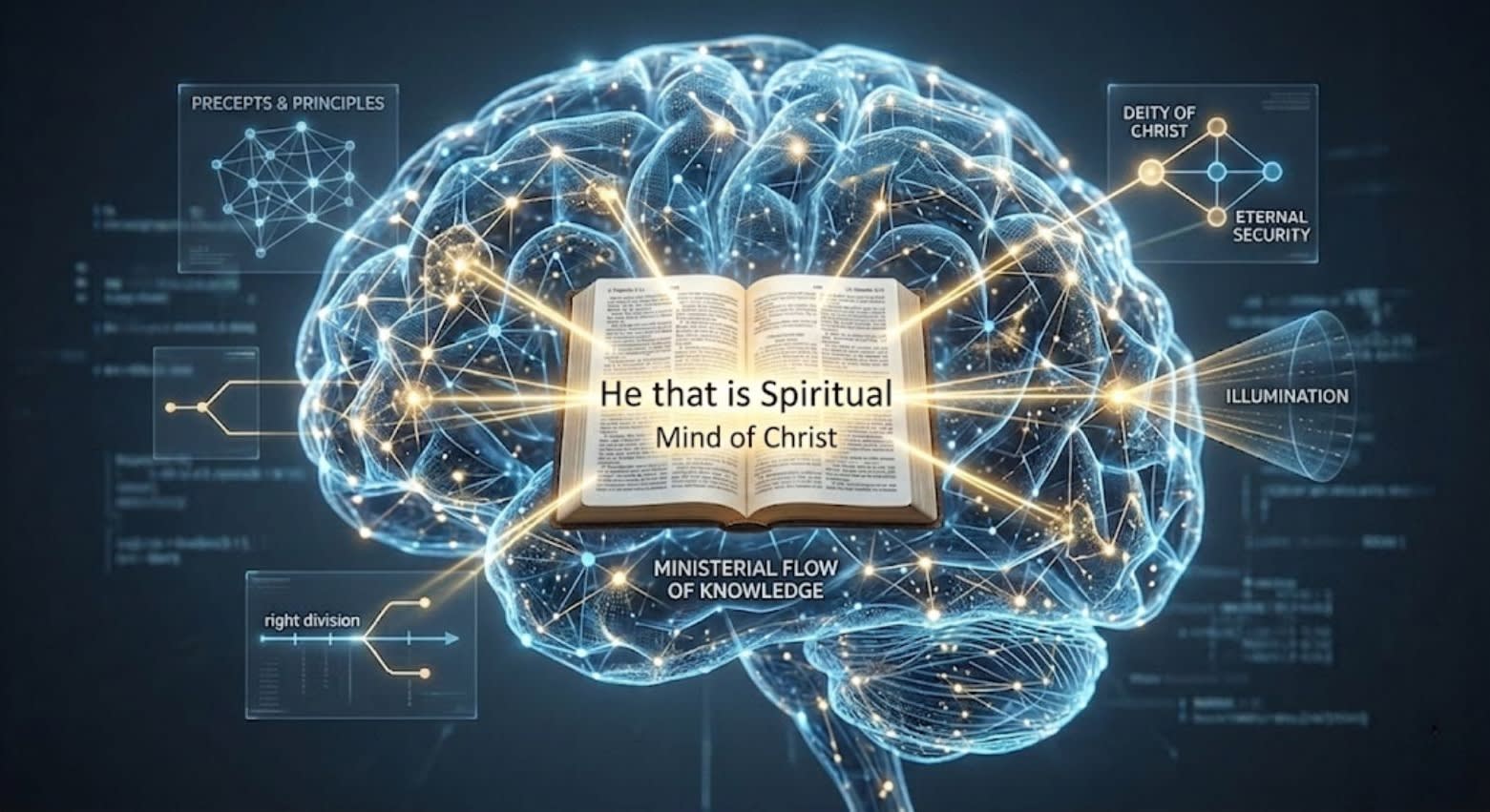
True spirituality is the supernatural capacity to discern truth from error. A “spiritual” man is not defined by outward performance but by the ability to identify and judge faulty worldviews, heretical philosophies, and the “wrong division” of Scripture using the Mind of Christ.
The Mismeasure of a Man: Context vs. Performance
In my experience, the phrase “he that is spiritual” is hijacked and repurposed as a tool for behavioral modification in many “Fundamentalist” circles. It is often treated as a badge of honor awarded to those who strictly adhere to outward Key Performance Indicators (KPIs): modest dress, consistent attendance, and faithful tithing.
While these have value in a believer’s walk, using them as the primary measure of maturity sacrifices the context of 1 Corinthians 2. When spirituality is reduced to a checklist, the preacher becomes a manager of behavior rather than a steward of the Truth.
The Mandate of Discernment: “Judgeth All Things”
According to 1 Corinthians 2:15, “he that is spiritual judgeth all things.” This identifies a critical epistemological function: the spiritual man is a judge. His maturity is not measured by his conformity to a ministry’s cultural agenda, but by his ability to weigh and value reality through the lens of God’s word.
-
Identifying Faulty Worldviews: The spiritual man recognizes the “rudiments of the world” and the “philosophy and vain deceit” (Colossians 2:8) that underpin secular thought.
-
He can strip away the veneer of humanism, materialism, and psychological self-help to reveal their incompatibility with the Mind of Christ.
-
-
Judging Heretical Philosophies: True spirituality provides the “spiritual hardware” to detect when a teaching contradicts the nature of God or the finished work of Christ.
-
He is not “tossed to and fro” by every wind of doctrine because he compares “spiritual things with spiritual”—Scripture with Scripture.
-
The Theological Standard: Sound Doctrine and Right Division
A robust Revelatory Epistemology (how we know what we know) requires the spiritual man to be an expert in the “word of Truth.” This involves more than just reading; it involves the active judgment of theological subjects through study and real-world application.
-
Correcting “Wrong Division”: A primary mark of a spiritual man is the ability to identify the “wrong division” of Scripture.
-
He recognizes when someone is misapplying a Tribulation command or a Kingdom promise to the Church Age. He understands that “right division” (2 Timothy 2:15) is not just a method, but a divine prescription for avoiding “yea and nay” (contradictory) doctrine.
-
-
Evaluating Theological Systems: The spiritual man judges systems that attempt to force an isolated interpretation of Scripture that violates the broader context of God’s preserved words.
-
He stands as a steward of the Truth, ensuring that personal convictions never supersede the explicit propositional truth of the King James Bible.
-
Conclusion: From Performance to Stewardship
We must resist the urge to turn spirituality into a “salesmanship” performance. If a man dresses perfectly and attends every service but cannot discern a heretical philosophy or identify “wrong division,” he is not “spiritual” in the Pauline sense; he is merely a well-behaved “natural” or “carnal” man. While the context of 1 Corinthians chapter 2 distinguishes a “carnal” man as being lost, and not possessing the Holy Spirit, it is certainly possible for the Christian to walk as other Gentiles do, “in the vanity of their mind” (Eph. 4:17).
-
The Spiritual Man: Possesses the Mind of Christ (the Scriptures are a reflection of God’s mind) to judge worldviews and doctrines.
-
The Performance Christian: Possesses a checklist to satisfy human leaders.
Examine Ourselves
Paul encouraged us to engage in self-examination. This practice is beneficial as it helps ensure our thoughts align with the Word of God rather than being driven by our emotions or human reasoning (1 Cor. 9:3, 11:28; 2 Cor. 13:5).
Here are some simple questions to consider to help assess our commitment to truth and our growth in “the grace and knowledge of our Lord and Savior Jesus Christ.”
-
Can I explain to a friend, using only the Bible (not your phone, not the internet, not AI), that Jesus Christ is not just a good man or a teacher but is actually God manifest in the flesh?
-
Do I believe the Bible is true because I’ve studied it and God has shown me, or just because my parents or preacher told me so?
-
When someone asks me a question about God, do I give them my opinion, or can I point them to a specific verse in the King James Bible from memory?
-
When I read the Bible, do I know how to “rightly divide” it so I don’t get confused by verses that seem to contradict each other?
-
Can I clearly identify the progression of Covenant revelations from Genesis to Revelation to demonstrate the correct division of Scripture as a whole?
-
When I watch a movie or listen to music, can I spot a “false worldview” (an idea that goes against God) even if the song or movie is popular?
-
How often do I engage the world openly and honestly with the word of God on a weekly basis?
-
Can I deconstruct secular philosophies into their core components and evaluate those assumptions against a biblical worldview?
-
When was the last time I successfully defended the Biblical worldview against false doctrine, heresy, or any “high thing that exalteth itself against the knowledge of God”?
True maturity is found in the balance of knowledge and application. We must remain loyal to the context of 1 Corinthians 2: the spiritual man is the one to whom God has revealed His “deep things,” granting him the wisdom to see through the “foolishness” of the world and stand firmly in the word of God.